|
Introduction
Let us say that a company wishes to enter into the Canadian market and the business requires a distribution centre to be positioned in an optimal location to service the entire country. If one threw a dart at the Canadian map in search of the optimal distribution epicentre, then it would land squarely in Mississauga very close to Toronto’s Pearson International Airport. This is no secret as the entire Mississauga / Brampton region and surrounding environs have evolved into the Canadian Mecca for companies to distribute goods across the country.
Lately a new trend is emerging whereby a number of companies have decided to strategically position their distribution centres in another unexpected location further east down Highway 401 in none other than Cornwall, Ontario. In this article we review the companies that have decided set up distribution centres in Cornwall and the reasons why we believe this is happening. Aside from being geographically well-positioned, Cornwall offers several fundamental advantages which have a strong influence on strategic corporate decision making including:
(1) Relatively inexpensive land cost and on-going taxation rates
(2) An available labour force suited to blue collar shift work
(3) Low penetration of organized labour
(4) A good level of business-friendliness as it pertains to provincial and regional political policies.
Background Information
Cornwall is Ontario’s eastern most city located alongside the St. Lawrence River and the Trans-Canada Highway (401). Cornwall is a mid-sized Canadian city with a population of about 46,000 people. It is located along the 45th parallel, approximately 100 kilometers (62 miles) southeast of Ottawa, the national capital, 120 kilometers (75 miles) southwest of Montreal, Quebec's largest city, and 400 kilometers (250 miles) northeast of Toronto. It is important to note that Cornwall is approximately 40 kilometers (25 miles) or 30 minutes west of the provincial border that divides Ontario and Quebec.
Historically, Cornwall has been home to a once thriving cotton industry and in the 1990’s it had a strong pulp and paper industry which went into demise when Domtar shuttered a plant in 2006. Aside from some chemicals production, Cornwall has not been of any major strategic importance as far as industry is concerned. Cornwall has certainly never been thought of as a strategic distribution hub until 2000. That is when Walmart came to town in a big way.
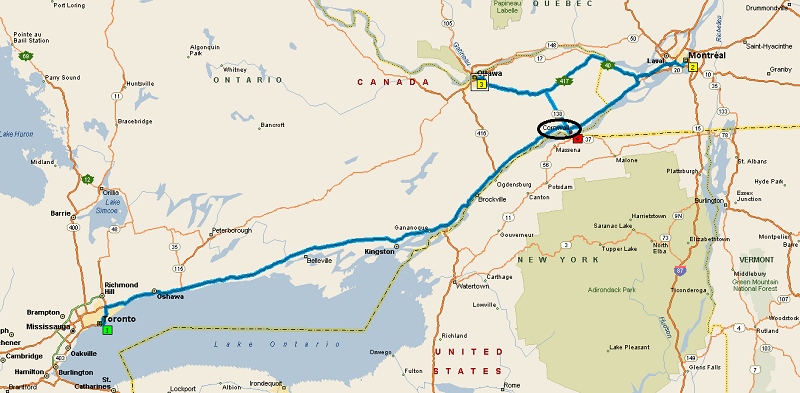
The map above depicts Cornwall and its relative distance to Montreal, Ottawa and Toronto.
Walmart Canada Sets Up a Distribution Centre in Cornwall
In 1994, Walmart entered the Canadian market by acquiring an existing retail chain of 122 Woolco stores from Woolworth Canada. At the time, many of Woolco’s retail stores, as well as the its distribution centres, were unionized. Walmart made the decision not to acquire the Woolco stores that were either unionized or had downtown locations. To avoid the unions in the distribution centres, Walmart decided to outsource distribution to a third party logistics provider called Tibbett & Britten Group Canada Inc. (TBGC) which ended up founding a new company called Supply Chain Management Inc. to provide Walmart with dedicated retail logistics services. As a side note, in 2004 Exel plc acquired Tibbett & Britten and then in December 2005, Exel was subsequently acquired by the Deutsche Poste World Net (DWPN).
Since 1994, SCM has successfully worked with Walmart to deploy and operate multiple large-scale ambient distribution centres across Canada in Mississauga, ON to service the Greater Ontario market; in Calgary, Alberta to service the Western market; and in Cornwall, Ontario to service Quebec and the Atlantic Provinces. Today, the Walmart distribution centre in Cornwall was originally opened in 1999/2000 and has since been expanded to 1.42 Million square feet with an estimated construction cost of $75 Million. It is Cornwall’s largest employer with close to 1,000 associates working at the facility and it is one of the largest distribution centres in Canada (Ed. note: The SCM distribution centre in Cornwall was taken over by Walmart in 2014).
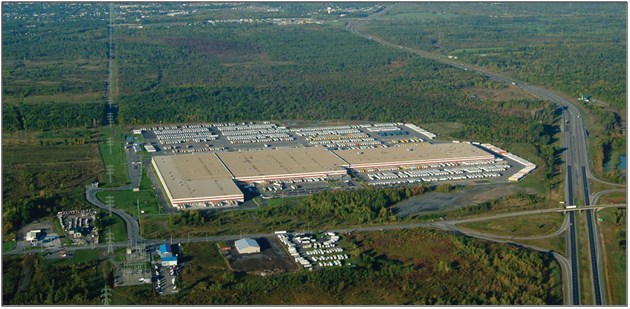
Supply Chain Management Inc. is a 3PL that operates one of the largest distribution centres in Canada located in Cornwall, Ontario for Walmart Canada. The wooded area behind the facility shows the land earmarked for future business park expansion.
Cornwall Attracts Companies and Evolves Into a Strategic Distribution Hub
After 2000, things were relatively quiet for Cornwall up until recent years when suddenly some high profile new distribution centre projects were announced.
- In October, 2010, Shoppers Drug Mart opened a new 550,000 square foot distribution centre on a 64 acre property in Cornwall’s main industrial park right beside the Supply Chain Management facility. The Shoppers Drug Mart facility is 45’ high and employs approximately 130 full-time associates. The operation was outsourced to a third party logistics provider (Matrix Logistics Services Ltd.).
- In August, 2011, Target Canada announced its intention to construct a new 1.4 Million square foot distribution centre which opened in 2013. The facility is located on a 169 acre property on Industrial Park Road in the Cornwall Business Park and the operation is outsourced to Eleven Points Logistics (EPL is a subsidiary of Genco). The Target facility will service stores in Quebec and Eastern Canada. Approximately 400 new jobs were created at the time of start-up. As part of the deal, the city of Cornwall made a $4-million investment to extend road and sewers to the site to accommodate this project and future development.
- It is important to note that Target only recently entered into the Canadian market through its acquisition of 189 Zellers store leases.
- In March, 2012, Zellers announced that it will close its 400,000 sq. ft. Pointe Claire distribution centre which is in the west end of Montreal about 1 hour down the highway from Cornwall. The facility closure will result in an estimated loss of 300 unionized (CAW) jobs and is directly related to the new Target facility handling volume for the Quebec market and . Furthermore, Zellers closed distribution centres in Scarborough, ON and Calgary, AB at the end of 2012.
- From our database of retail distribution centres across North America, a high volume mechanized general merchandise facility of 1.4 Million square feet can employ up to 1000 full-time associates.
- Boundary Properties has acquired 121 acres of land which is rumored to be the future home of a large facility. Reliable sources have indicated that it may be a grocery distribution centre to be constructed for Loblaws. Unconfirmed sources indicate that work has now started on building construction.
- Other companies that have moved production and/or distribution operations to the Cornwall area prior to 2000 include:
- Ridgewood Furniture, a division of Dorel Industries, operates a 500,000 sq. ft. ready to assemble furniture manufacturing plant which has been expanded several times since 1987.
- Richelieu Hosiery has a 73,000 sq. ft. facility which distributes leg wear products and accessories to retailers.
- Pharmetics is a leading OTC and nutrition contract manufacturer with a 60,000 sq. ft. distribution centre.
- Benson Autoparts is a local family-owned business that operates a 213,000 sq. ft. distribution centre to service tires and automobile parts a chain of retail stores in Eastern Ontario and Western Quebec. In 2013 the company announced its intent to acquire a 217,000 sq.ft. building across the street from its Headquarters resulting in a total footprint of 430,000 sq.ft. of building space on 60 acres.
- Olymel Prince Foods has a Pork production facility in Cornwall that temporarily laid off 320 full-time UFCW employees in August, 2011 after the Canadian Food Inspection Agency (CFIA) suspended their operating license because of “regulatory non-compliance issues.” The company has since recovered and has been hiring new employees in 2013.
- As of 2013, the Cornwall Business Park is home to over 3.87 Million square feet of industrial space.
Why Are Companies Considering Cornwall as a Distribution Hub?
There is a number of reasons that companies have moved to Cornwall, Ontario to establish their distribution / production operations. Without a doubt, the Cornwall Economic Development group has done a great job promoting Cornwall as a strategic distribution hub. In speaking with Mark Boileau, Economic Development Manager for the City of Cornwall, the following reasons were provided as being advantages to doing business in Cornwall:
- The land that is being offered for sale in the Cornwall Business Park is selling for about $20,000 per acre fully serviced which is very reasonable when one considers that land costs can reach upwards of $700,000+ per acre in in cities such as Vancouver and Calgary. In general, start-up costs are also relatively low.
- labour availability is presently not an issue in 2011. The cost of living is relatively low in Cornwall which enables the city to attract people from other parts of Eastern Ontario to meet the increasing demand for manpower requirements. To this end, the town of Cornwall is actively working to attract people from cities such as Ottawa and Montreal.
- The city has in previous years been home to pulp and paper/chemicals production facilities hence there is an experienced blue collar labour force that has been exposed to shift work.
- Cornwall has a port and a land bridge to the United States which offers inbound transportation efficiencies.
- Cornwall is positioned close to Montreal and Ottawa thus the location serves as an ideal location to service customers in Eastern Ontario, Quebec and the Atlantic Provinces.
- Wage rates and operating expenses in Cornwall, and Eastern Ontario in general, are typically lower than in the nearby major cities.
- Lower tax rates and universal healthcare coverage are cited as other advantages relative to locations within the U.S.
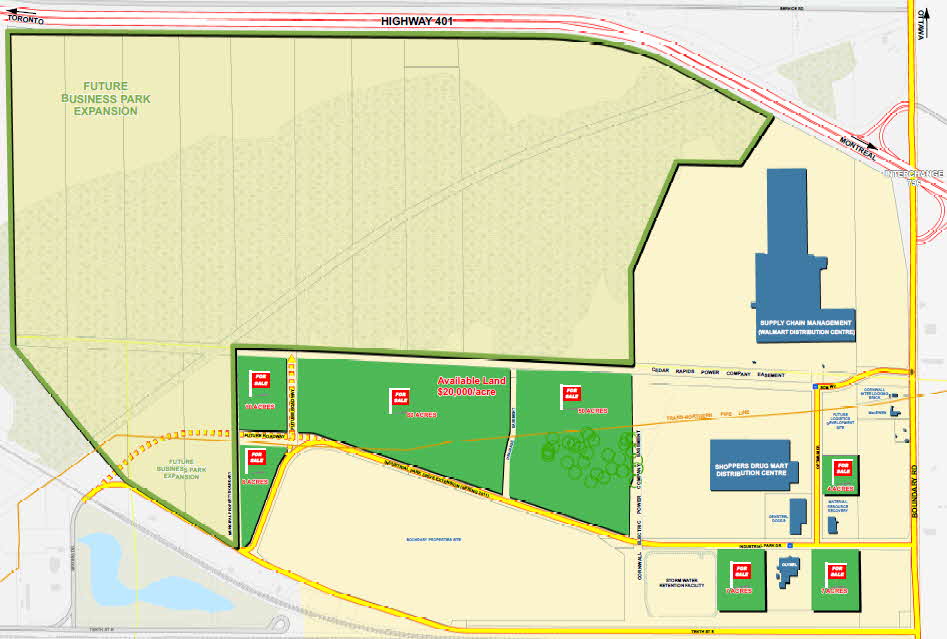
Map of the Cornwall Business Park. The 2 larger existing blue buildings from top to bottom are Supply Chain Management (Walmart Canada) and Shoppers Drug Mart.
Key Strategic Issues for Government and Union Leaders to Consider
Without a doubt, the reasons cited above offer a strong set of incentives for distributors to set up shop in Cornwall. Having said this, now is the time for union leaders and elected government officials to pay close attention to what is happening in Cornwall for the following reasons:
- Large retailers that have non-union labour forces within their distribution centres have a significant labour cost advantage over competitors with unionized labour forces. Companies need to remain non-union to keep operating expenses down otherwise they cannot be price competitive at retail. These companies make decisions on where they will set up their distribution centres with the issue of avoiding organized labour whenever possible at the front and centre of their decision making process.
- Notice that most of the companies that have entered Cornwall, or have plans to enter Cornwall, are doing so with a labour force that is employed through a 3rd party logistics company? Why is that? Why would a company be willing to operate such a major strategic asset through a third party service provider?
- In our opinion, it certainly is not because these companies are amateurs at distribution and therefore they are seeking vastly superior distribution expertise from a 3PL that can run the operation better than what they can execute internally. Make no mistake; these companies are some of the strongest logistics operators in North America.
- It is not because these distribution centres are small regional outposts and it makes sense to hand off the operation to a 3PL because it is more cost effective to do so. The facilities going into Cornwall are among the biggest in Canada.
- It certainly is not because the 3PL provides a cheaper overall solution as compared to not using a 3PL. The 3PL needs to make a profit margin of say 13% on everything it manages hence this is a signifivant incremental cost that is added to the logistics operating budget to pay for the 3PL’s management fee. This cost would be eliminated if the labour force was employed directly by the distributor.
- The reality is that these companies are deploying their distribution centre labour forces through 3PL companies to establish an arm’s length relationship between the employer and the retailer. This is a labour strategy pure and simple and one that is effective at reducing the potential for organized labour to obtain a foothold in the operation. This phenomenon is nothing new and is certainly not unique to Cornwall or even Canada. This is a business strategy that has been long underway in the U.S. and has entered into Canada as a defense against union militancy and the threat of being held hostage from a strike or other labour tactics. Even though the use of a 3PL may add cost, companies are willing to pay this premium because ultimately it ensures a non-union labour force that is substantially less costly than a unionized labour force. This is a harsh business reality that we predict will proliferate into the future as more and more companies exercise their options to protect their businesses to remain competitive.
- Notice that these companies have chosen Cornwall, Ontario over say nearby locations across the provincial border in Quebec? Why is that?
- The city of Montreal proper has a population of 1.6 Million people with an estimated metropolitan area population of nearly 3.9 million people. There are plenty of qualified places in Quebec such as Coteau-du-Lac (Canadian Tire built a massive state of the art 1.6 Million sq. ft. automated distribution centre here in 2007 for $125 Million) or Terrebonne (Sobeys is planning to build a fully automated 470,000 sq. ft. distribution centre here to open in 2013).
- Cornwall is the Eastern-most city before the Quebec border. These companies are setting up their distribution centres in Cornwall instead of Montreal for the simple reason that given the choice, they would rather do business in Ontario than Quebec. While this is clearly a touchy subject, the truth is that Cornwall has won hundreds of jobs and millions of dollars in tax revenues because of Quebec’s failure to be business-friendly enough. The province of Quebec would love to have more job creation but it is in many ways its own worst enemy. Behind closed doors, business executives will discuss the types of issues that Quebec has to address in order to lure more distributors to the province. Key issues that Quebec has to solve include:
- Less political bureaucracy – Quebec is the only province that has two separate taxation systems which significantly increases administrative expense.
- Higher fuel prices – Quebec is consistently between 5 to 10 cents higher per litre than neighboring Ontario which is purely because of imposed provincial taxes. This burden is a major disadvantage given that distributors have to run major trucking operations to move goods to market.
- Quebec has a highly unionized labour force as compared to Ontario which has a large non-unionized labour force. Unionization rates in Canada vary by province and by industry. In general, the unionization rate in Canada has decreased gradually over time, falling from 33.7% in 1997 to 31.4% in 2009. In 2009, 39.8% of Quebec workers belonged to a union as compared to Ontario at 27.6%.
- Quebec has strict language laws and labour laws that make it highly unattractive for big companies from the U.S. and the rest of Canada to set up distribution centres in the province. The business reality is that companies that are not Quebec-based simply do not wish to incur the additional expense, human resource requirements and hassle factor to adhere to Quebec’s political policies. Recently, Target Corporation learned this the hard way in January, 2011, when the company met with Quebec’s Labour Minister Lise Thériault who outlined the province's distinct work rules. Target acquired 220 Zellers stores across Canada and has plans to convert them to Target outlets by 2014. Target has said that because it only acquired Zellers' leases, it can terminate contracts for current staff when it takes over. Certain employees will then have to reapply to work for Target. Under Quebec's Labour Standards Act and the Civil Code, the partial sale of a company does not put an end to employees' contracts. Zellers is unionized under the UFCW and the union says that employees are worried about the takeover, and warn the plan could be illegal in Quebec given its strict labour laws. No less than 7 months later Target announced Cornwall, Ontario as the location for their new distribution centre, a decision that should make it clear to any union leader or politician that companies will not do business in places where the business climate is unfavourable.
Cornwall Transportation Perspective
There are future prospects to increase the efficiency of intermodal truck/rail freight transportation into Cornwall. These prospects are described in detail within a great white paper from Mr. Harry Valentine which you can access by clicking here.
Conclusions
Well, no doubt that I have probably ruffled some feathers along the way by publishing this article. I think it is important to educate people from all walks of life to better understand how and why strategic supply chain decisions are made. I think it is also important to understand that the least expensive decision is not necessarily the decision that is taken by business leaders and that there are other critical non-economic issues that influence the decision making process. We talked about some of them in this article – particularly as it relates to the subject of organized labour and government’s failure to establish a business-friendly environment for companies.
While the reader may disagree with some of the points of view set forth within the article, our intent is to offer insight into why jobs in the distribution sector are being created in abundance in Cornwall. Eastern Ontario and Cornwall in particular is certainly to be congratulated on their success in attracting businesses and creating wealth for its residents. To the victors go the spoils.
Marc Wulfraat is the President of MWPVL International Inc. He can be reached at +(1) (514) 482-3572 Extension 100 or by clicking here. MWPVL International provides consulting services to help companies achieve logistics excellence. Our services include: distribution network strategy; distribution centre design; material handling and automation systems; supply chain technology consulting; product sourcing and purchasing; transportation consulting; and operational assessments.

|




















